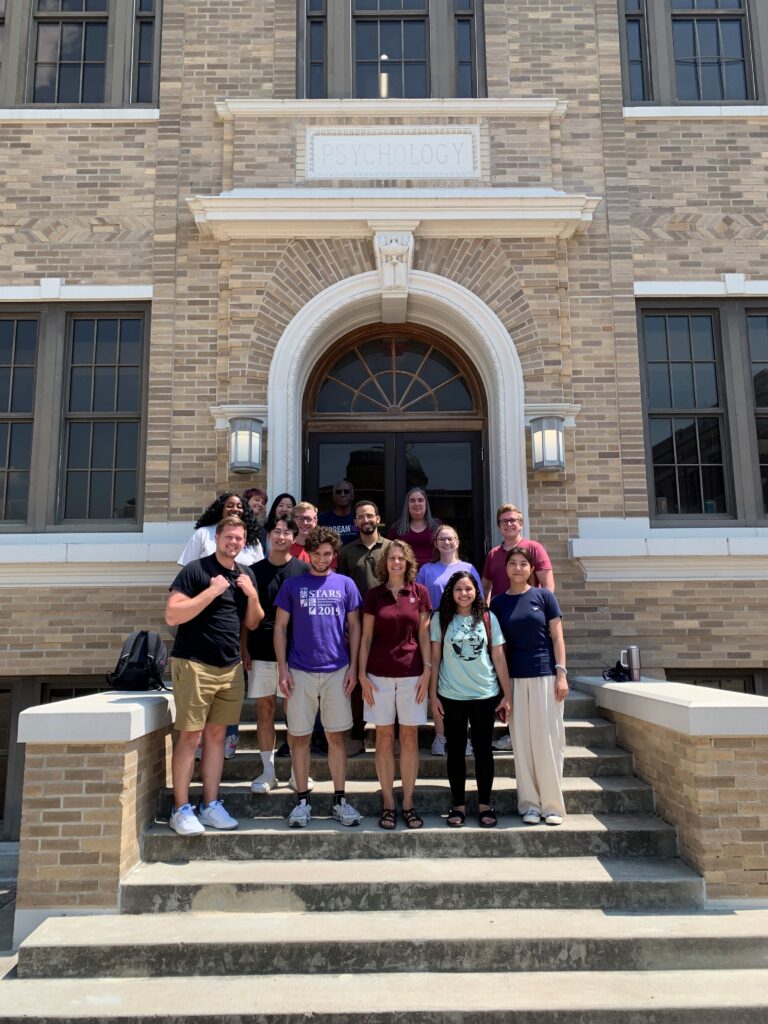
Dr. Mark Packard

Professor
Ph.D. McGill University


Department of Psychology
Texas A&M University
College Station, TX 77843-4235

Office: 210 Psychology Building
email: mgp@psyc.tamu.edu
Phone: (979) 845-9504
Fax: (979) 845-4727


Area(s) of Specialization
Behavioral and Cellular Neuroscience

Current Research

The primary focus of research in our laboratory is on the neurobiological bases of memory. Evidence indicates that memory is not a unitary phenomenon, but instead is organized in multiple brain systems that differ in terms of the type of memory they mediate. Our research emphasizes identification of neural structures mediating different forms of memory, investigation of the neurochemical bases of multiple memory systems, and elucidation of the psychological operating principles that distinguish different types of memory. In particular, we have dissociated the role of the mammalian hippocampus and basal ganglia in ?cognitive? and ?habit? memory processes, respectively, and investigated the role of dopaminergic, cholinergic, and glutamatergic neurotransmission in these forms of memory. Other findings from our laboratory suggest that a third brain structure, the amygdala, plays a general modulatory role in memory, such that activation of this structure influences both hippocampal-dependent and striatal-dependent memory storage processes. Additional research interests include examination of hormonal influences on cognition, and the interaction of sex steroids with brain reward systems. A long-range goal of our research is to understand the implications that a multiple systems hypothesis of memory organization has for several areas of psychological research.

Selected Publications
  1. Packard, M. G. & Knowlton, B. J. (2002). Learning and Memory Functions of the Basal Ganglia. Annual Review of Neuroscience, 25, 563-593.


  2. Packard, M. G. and Cahill, L. (2001). Affective modulation of multiple memory systems. Current Opinion in Neurobiology, 11, 752-755.


  3. Packard, M. G. (1999). Glutamate infused post-training into the hippocampus or caudate-putamen differentially strengthens place and response learning. Proceedings of the National Academy of Sciences, 96, 12881-12886.


  4. Packard, M. G., Cahill. L., & McGaugh, J. L. (1994). Amygdala modulation of hippocampal-dependent and caudate-dependent memory processes. Proceedings of the National Academy of Sciences, 91, 8477-8481.


  5. Packard, M. G., Hirsh, R., & White, N. M. (1989). Differential effects of fornix and caudate nucleus lesions on two radial maze tasks: evidence for multiple memory systems. Journal of Neuroscience, 9, 1465-1472.
Research Interest Groups
Emotion Research Focus Group


This site is best experienced with Microsoft's Internet Explorer 6 brower.

If you have questions or comments concerning this website, please contact the webmaster at:  sgupta@psych.tamu.edu