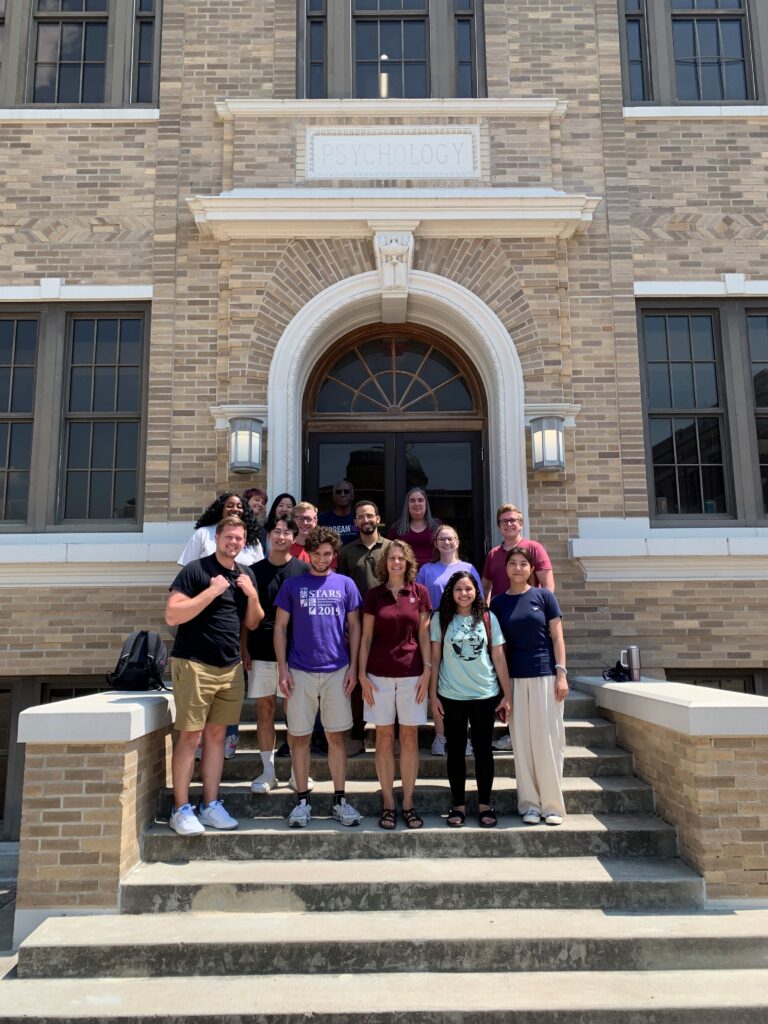
Dr. Steven Smith

Professor
Ph.D. University of Wisconsin (1979)


Department of Psychology
Texas A&M University
College Station, TX 77843-4235

Office: 276 Psychology Building
email: stevesmith@tamu.edu
Phone: (979) 845-2509
Fax: (979) 845-4727
Web: http://www.t...tevesmith/


Area(s) of Specialization
Cognitive Psychology

Research Interests

  • Human Memory: recovered and false memories, memory blocks, eyewitness memory, aging and memory, context-dependent memory
  • Creative Cognition: fixation, incubation, insight, conceptual combination
  • Metacognition: tip-of-the-tongue states, metacomprehension

Current Research

My current research examines memory, creative cognition, and metacognition, particularly as these areas of interest deal with various types of impasses and their resolution. I am engaged in
laboratory studies of blocked and recovered memories, asking such questions as how accurate are recovered memories? Are distinctive and emotional materials subject to memory blocks and recovery? Are memory blocks and inhiition independent mechanisms of forgetting? In creative
cognition, I am interested in insight, incubation, and conceptual combination, and I am conducting both laboratory studies and applied research in engineering design and computer science. I also study metacognition, such as tip-of-the-tongue states and feelings-of-knowing.

For a current copy of my VITA, see my personal website at http://people.tamu.edu/~stevesmith/.

Grants

National Science Foundation (with A. Kerne, Computer Science), "Extending Working Memory Functions by Representing Bookmark and Result Sets as Visual Compositions." 2004-2005.

National Science Foundation (Steven M. Smith, Principal Investigator), National Science Foundation Engineering Education & Centers (EEC) Division of Design, Manufacture, & Industrial Innovation (DMII), (with Jami Shah, Mechanical Engineering, Arizona State University), "Development and validation of design ideation models for conceptual engineering design." $360,000 over three years.

American Psychological Association Scientific Conferences Program, "Conceptual Structures and Processes: Emergence, Discovery, and Change" (with Thomas Ward and Jyotsna Vaid): $14,000 awarded.

National Institute of Mental Health, "Inducing and Reducing Cognitive Fixation" (Grant No. 1 R01 MH447030), September, 1989- May, 1993); $228,974 awarded.

Selected Publications
  1. Smith, S. M. (2006). Context and human memory. In H. L. Roediger, Y. Dudai, & S. Fitzpatrick (Eds). Science of Memory: Concepts. Oxford University Press.


  2. Smith, S. M., and Gleaves, D. H. (2006). Recovered memories. In M. P. Toglia, J. D. Read, D. F. Ross, & R. C. L. Lindsay (Eds). Handbook of Eyewitness Psychology. Erlbaum Associates.


  3. Choi, H., & Smith, S. M. (2005). Incubation and the resolution of tip-of-the-tongue states. Journal of General Psychology: Experimental, Physiological, and Comparative Psychology, 132(4), 365-376.


  4. Smith, S. M., Gerkens, D. R., Shah, J., & Vargas-Hernandez, N. (2005). Empirical studies of creative cognition in idea generation. In L. Thompson & H. Choi (Eds). Creativity and Innovation in Organizational Teams. Lawrence Erlbaum Associates, Inc.: Mahwah, NJ.


  5. Kerne, A., & Smith, S.M. (2004). The information discovery framework. Proceedings of the Association for Computing Machinery, Designing Interactive Systems (DIS), 357-360.


  6. Gleaves, D. H., Smith, S. M., Butler, L. D., & Spiegel, D. (2004). False and recovered memories in the laboratory and clinic: A review of experimental and clinical evidence. Clinical Psychology: Science and Practice, 11, 3-28.


  7. Smith, S.M. (2003). The constraining effects of initial ideas. In P. Paulus & B. Nijstad (Eds). Group Creativity: Innovation Through Collaboration. (pp. 15-31). Oxford University Press.


  8. Shah, J.J., Vargas-Hernandez, N., & Smith, S.M. (2003). Metrics for measuring ideation effectiveness. Design Studies, 24, 111-134.


  9. Smith, S.M., Gleaves, D.H., Pierce, B.H., Williams, T., Gilliland, T.R., & Gerkens, D.R. (2003). Comparing recovered memories with created ones: An experimental approach. Applied Cognitive Psychology, 16, 1-29.


  10. Smith, S. M., Gerkens, D. R., Pierce, B. H., and Choi, H. (2002). The roles of associative responses at study and semantically guided recollection at test in false memory: The Kirkpatrick and Deese hypotheses. Journal of Memory and Language, 47 (3), 436-447.


  11. Smith, S.M., & Vela, E. (2001). Environmental context-dependent memory: A review and meta-analysis. Psychonomic Bulletin and Review, 8, 203-220.


  12. Smith, S.M., Tindell, D.R., Pierce, B.H., Gilliland, T.R., & Gerkens, D.R. (2001). Source memory failure in episodic confusion errors. Journal of Experimental Psychology: Learning, Memory & Cognition, 27, 362-374.


  13. Smith, S.M., & Tindell, D.R. (1997). Memory blocks in word fragment completion caused by involuntary retrieval of orthographically similar primes. Journal of Experimental Psychology: Learning, Memory and Cognition, 23(2), 355-370.


  14. Ward, T.B., Smith, S.M. & Vaid, J. (1997). Creative Thought: An Investigation of Conceptual Structures and Processes. Washington, DC: American Psychological Association Books


  15. Smith, S.M., Ward, T.B., & Finke, R.A (eds). (1995). The Creative Cognition Approach. In (Ed). . Cambridge: MIT Press.


  16. Finke, R.A., Ward, T.B., & Smith, S.M. (1992). Creative Cognition: Theory, Research, and Applications. In (Ed). . Cambridge, MA: MIT Press.
Presentations

Smith, S. M. (2005). Context-dependent memory. Presented at the Science of Memory conference, Palisades, New York, NY.

Smith, S. M. (2005). Research in creative cognition. Presented at the Cognitive Forum, University of California, Los Angeles, CA.

Smith, S. M. (2004). Clue insensitivity in memory and problem solving. Symposium speaker, British Psychological Society, Imperial College, London, England.

Smith, S. M. (2004). The science of creative cognition. Invited address, British Psychological Society, Imperial College, London, UK.

Smith, S. M., Gerkens, D. R., Choi, H., & Hull, R. G. (November, 2003). Forgetting and recovery without inhibition. Poster presented at the annual meeting of the Psychonomic Society, Vancouver, B.C.

Smith, S. M. (2003). Empirical Studies of Creative Cognition in Idea Generation. Invited speaker at the KTAG conference on creativity and innovation. Northwestern University, Evanston, IL.

Smith, S. M., Choi, H., Gerkens, D. R., & Hull, R. G. (November, 2002). Resolving memory blocks. Presented at the annual meeting of the Psychonomic Society, Kansas City, Missouri.

Smith, S.M., Choi, H., Gerkens, D.R., and Pierce, B.H. (June, 2002). Incubation and Recovery from Tip-Of-the-Tongue States. Presented at the annual convention of the American Psychological Society, New Orleans, LA.

Smith, S.M., Choi, H., Gerkens, D.R., Pierce, B.H., and Flesch, M.H. (November, 2001). Clue Insensitivity in Memory Recovery. Presented at the annual meeting of the Psychonomic Society, Orlando, FL.

Smith, S.M. & Choi, H. (2001, August). Incubation in Memory, Problem Solving, and Idea Generation: Autonomous Unconscious Processing vs. Contextually Influenced Restructuring. Presented at the Third
International Conference on Memory, Valencia, Spain.

Smith, S.M. (2000, November). Did that really happen, or was it just a dream? Paper presented at the Annual Meeting of the Psychonomic Society, New Orleans, LA.

Smith, S.M. (June, 2000). Creativity in design. Presented at the Gordon Research Conference on Theoretical Foundations for Product Design and Manufacturing, Plymouth State College, Plymouth, NH.

Awards and Honors

Liberal Arts College Teaching Award

Invited Lecturer and Adjunct Professor at Southwest China Normal University, Chongqing, China

Courses Taught

Undergraduate
PSYC 107 - Introduction to Psychology
PSYC 345 - Human Cognitive Processes

Graduate
PSYC 603 - Motivation and Cognitive Processes
PSYC 689

Link to Vita

Link to Vita

Research Interest Groups
Emotion Research Focus Group


This site is best experienced with Microsoft's Internet Explorer 6 brower.

If you have questions or comments concerning this website, please contact the webmaster at:  sgupta@psych.tamu.edu