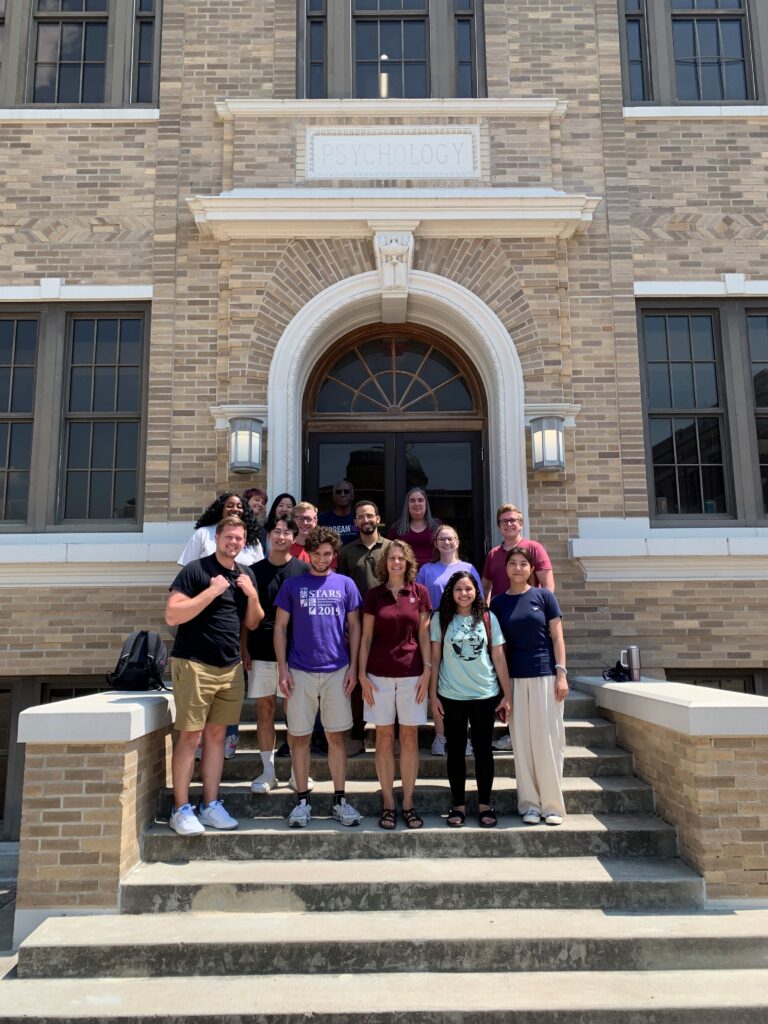
Psychology Department Programs and Goals
The goals of the Ph.D. program in Psychology are: 1) to prepare students
for careers as researchers and teachers at colleges and universities,
and 2) to prepare students for careers as scientist-practitioners in
clinical psychology and industrial/organizational psychology.
*The Clinical Psychology program is accredited by the American Psychological
Association (APA). For additional information regarding our Clinical Program's training goals, objectives, and clinical and research competencies related to these, go to this link: TAMU Clinical Psychology Program Goals
In addition to the Department of Psychology's 6 areas of specialization, there are research focus groups that bridge traditional area groups.
The Psychology faculty is engaged in innovative research programs in
diverse areas of specialization. Recognized both nationally and internationally,
faculty members have received numerous awards for research and teaching.
Collectively, the faculty hold several million dollars in research grants
from the National Science Foundation, National Institute of Mental Health,
and other federal and/or state agencies.
The Department enrolls approximately 100 graduate students and offers
numerous opportunities for student collaboration with faculty. The student-faculty
ratio is approximately 3:1, which allows individualized attention to
develop research and/or professional skills.
Graduate students may gain further valuable experience by working with
one of several interdisciplinary centers and institutes on campus, including
the:
Children, Youth, and Families Initiative
Institute for Science, Technology, and Public Policy (Bush School of
Government & Public Service)
Public Policy Research Institute
Race and Ethnic Studies Institute
University Faculty in Neuroscience
Graduate Placement
Graduates of the Ph.D. program in Psychology have been placed in challenging
full-time positions in colleges and universities, medical schools, and
private and public organizations, such as the University of Notre Dame,
Tulane University, University of Missouri, University of Arizona, University
of Oklahoma, State University of New York at Albany, Canada's University
of Western Ontario, San Diego State University, University of Hawaii,
University of Texas at Arlington, Xerox Corp., State Farm Insurance
Co., Personnel Decisions International, and The Psychological Corporation.
Over the last decade, all graduates have obtained full-time employment
as researchers, teachers, or practitioners. Faculty members are heavily
involved in the placement of graduate students.
Graduate Admissions
Admission to the Ph.D. program in Psychology is competitive. Students
admitted to the program typically have GRE (Verbal + Quantitative) scores
of 1200 or above, and GPAs of 3.50 or higher. The Department does not
accept applications from individuals seeking a terminal master's degree.
Click here for
more information about admissions procedures.
For additional assistance, contact:
Department of Psychology
Graduate Admissions Supervisor
Texas A&M University
College Station, TX 77843-4235
gradadv@psyc.tamu.edu
(979) 458-1710
Financing Your Graduate Education
All students admitted to the Psychology Ph.D. program receive a monthly
salary from either a graduate research or teaching assistantship, or
a scholarship. The salary associated with these positions is competitive
and varies with the type of award. Need-based financial aid and loans
are also available through the Department
of Student Financial Aid.
Internships
Pre-doctoral internships in the Psychology Clinic are required for
all Clinical students as part of their training in assessment and therapy.
A year long, paid internship away from campus at a clinic or hospital
is required for licensure in Clinical Psychology. Internships are recommended
for Industrial/Organizational (I/O) students who seek careers as practitioners
in the private sector, government, or consulting firms. The Clinical
and I/O programs have established reputations for providing well qualified
graduate students to fill internship positions in a wide variety of
organizations within Texas and nationally. Internship placements often
result in job offers for students following completion of their degree.
Facilities
The Department is housed in an attractive four-story building that
contains faculty and graduate student offices, research laboratories,
administrative offices, and classrooms. Laboratory facilities are excellent,
including labs designated for faculty and student research in behavioral
neuroscience, cognitive, developmental, industrial/organizational, and
social psychology. The Department also maintains a Psychology Clinic
in which Clinical students are trained to provide a range of psychological
services and conduct applied research under supervision from the Clinical
faculty.
Offices are provided for all graduate students. Microcomputers are
readily available for student use in laboratories and offices. The Texas
A&M Computing & Information Services Center maintains six large
computing centers connected by a campus-wide fiber optic network. Texas
A&M computing facilities are among the best in the nation.
Three libraries support faculty and graduate student research. Evans
Library holds more than 2 million volumes and subscribes to over 14,000
journals. The Medical Sciences Library is home to more than 100,000
volumes and subscribes to over 2,000 journals. The Saul B. Sells Collection
in the Psychology Building contains 4000 volumes and subscribes to many
of the most important journals in psychology.
In addition, graduate students and faculty have convenient web access
to electronic delivery of journal articles and book chapters.
Diversity
The Department is committed to the goal of achieving diversity among
the students admitted to its Ph.D. program. We strongly encourage applications
from women and members of ethnic minority groups and other groups that
are traditionally under-represented in graduate studies.
Housing
Although limited on-campus housing is available
in University-owned apartments, most graduate
students live off-campus. There are many apartments,
duplexes, condos, and rental houses within
a few minutes drive, bike ride, or walk from
campus. The University maintains an extensive
shuttle bus system that links many of the
primary housing areas in the community to
campus. The Off-Campus Student Services office
can help locate housing. For additional information
contact: Off-Campus Housing Center, Dept.
of Student Affairs, Texas A&M University,
College Station, TX 77843-1257, (979) 845-1741;
http://studentlife.tamu.edu/agoss.
This site is best experienced with Microsoft's Internet Explorer 6 brower.
If you have questions or comments concerning this website, please contact the webmaster at: sgupta@psych.tamu.edu
|