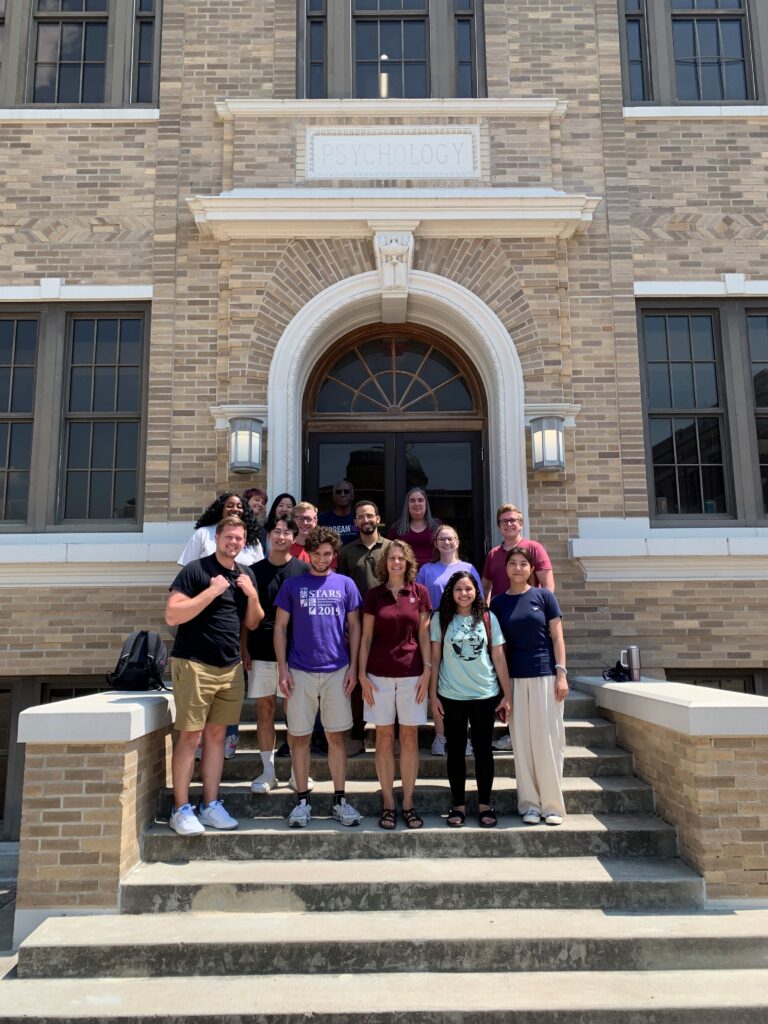
Psychology Department Information Handbook


Introduction

The Department of Psychology has prepared this booklet to provide students with information about the field of psychology, careers in psychology, and our undergraduate program. We hope this information will assist you in making a decision about your future in this field. If you have any further questions about our program, please feel free to contact the Undergraduate Advising Office at (979) 845-7146.

[Top]

What is psychology?

The American Psychological Association in its booklet Careers in Psychology defines psychology in the following manner: "Psychology as a discipline refers to the body of knowledge about human and animal behavior from which teachers teach. But, this knowledge must first be discovered to promote human welfare. Psychology includes a body of knowledge, methods of research to obtain such knowledge, and the application of that knowledge to benefit human kind (APA, p.2)."

[Top]

Areas in psychology

Most of the descriptions of psychological fields given below have been taken from the text Psychology: An Introduction To A Behavioral Science by Henry Clay Lindgren and Donn Byrne.

Clinical psychology is concerned with providing services for persons who have emotional or mental problems, with assisting people who are having difficulty adjusting to their current life situations, and with research on assessment, therapy, and psychopathology. The techniques they employ are diagnosis, psychotherapy, family therapy, behavioral therapy, and a variety of newer cognitive methods. Most clinical psychologists are employed in private practice, in the Veterans' Administration Hospitals, in mental health clinics, and in administrative jobs related to mental health. Others work at universities teaching and doing research to develop new and better techniques for helping people.

Cognitive psychology is concerned with the mental operations involved in thinking, acquiring knowledge, and using knowledge. Interests of cognitive psychologists include memory, perception, language, mental imagery, consciousness, problem solving, and creativity. Cognitive psychologists conduct both basic theoretical research as well as research applied to such areas as therapy, education, and industry.

Community psychology is concerned with the theoretical and practical issues related to planning community mental health needs. Community psychologists are interested in the examination and application of concepts drawn from interpersonal psychology, from management, and from social psychology or understanding the behavior of individuals in structured social systems (communities, schools, mental hospitals, prisons, etc.).

Counseling psychology: The differentiation between clinical and counseling psychology is currently decreasing. Counseling psychology is primarily involved in helping individuals with normal problems of everyday living (contrast this with the diagnosis and treatment of disturbed or abnormal behavior in people). Most counseling psychologists work in universities, colleges, and other educational settings, although many are employed by Federal, State, and Local Governments, and in hospitals, rehabilitation centers, community mental health centers, and private counseling agencies. They conduct interviews, give and interpret psychological tests, advise on career issues, and engage in therapy to help individuals change their behavior.

Developmental psychology studies the entire range of human development from the prenatal period through old age. Any aspect of thought, problem solving, social interaction, or other psychological processes that changes with age is considered relevant to the field. Its findings are used extensively by education, school, clinical, and counseling psychologists.

Educational psychology is concerned with problems of measurement and in conducting applied research relating to all aspects of education: classroom instruction, measurement of educational achievement, teacher training, problems of school administration, and so forth. Texas A&M's Educational Psychology Department is separate from the Psychology Department and College of Liberal Arts.

Experimental psychology is most strongly oriented to research. It includes those who are variously called learning psychologists, comparative physiological psychologists, perceptual psychologists, or general psychologists. Many are employed by colleges and universities, although increasing numbers now work for independent research laboratories or consulting firms.

Industrial/organizational psychology deals with organizational development, training and development, personnel research, employee motivation, and consumer psychology. Scientific specialties of industrial/organizational psychology include personnel psychology, organizational psychology, and consumer psychology.

Psychometrics is concerned with the development of tests and various kinds of statistical methods for the analysis of data. Some of the problems studied in this area are of an applied nature, while others involve "pure" research (research that does not necessarily have immediate application) particularly in the field of personality measurement.

School psychology: School psychologists typically work in elementary or secondary schools. They are concerned with school children in terms of their intellectual, social, and emotional development. School psychologists work not only with children who have problems in these areas, but with parents and teachers as well.

Social and personality psychology share many activities in common and involve both applied and pure research. A great deal of this research contributes directly or indirectly to the applied fields of clinical, counseling, community, educational, school, and industrial psychology. Research of the social psychologist focuses on group influences on the individual, interpersonal processes, attitude change, etc. Personality research focuses on stable traits within an individual. Most personality and social psychologists work in colleges and universities, but some are employed in government agencies or in research settings.

Other areas: There are numerous other areas of psychology, including Sport Psychology, Consumer Psychology, History of Psychology, Psychology of Women, Health Psychology, Psychology and Law, and Psychopharmacology. These very diverse fields are rapidly changing, and many psychologists now cross interdisciplinary lines aligning themselves with engineers, physical educators, computer scientists, physicians, business managers, and economists.

[Top]

What do psychologists do?

Psychologists teach, counsel, and work in research or administration to help understand people, their capacities, traits, and behavior and to explain their needs. The do this through interviewing and observing individuals, through testing, through the study of personal histories, and through controlled experiments. Psychologists normally hold doctorates (Ph.D., Psy.D., or Ed.D.) in psychology but they are not medical doctors, and cannot prescribe medication.

A doctorate in psychology (Ph.D. or Psy.D., doctor of psychology) is recommended for those who hope to make a career in the field. Psychologists do not need to attend medical school.

Psychologists who wish to enter private practice must meet certification or licensing requirements in all states and in the District of Columbia.

[Top]

Nature of work

The field of psychology is so vast that no one person can be an expert in all aspects of it. The psychologist usually concentrates on one specialty that is of particular interest. In many of the specialties, there is an overlap, in both subject matter and method used to handle it. Graduate preparation in the field of psychology, therefore, is based upon a common core of knowledge from which advanced graduates branch out when they begin to take up their own field of special interest.

Many psychologists work in colleges and universities, where they instruct in some area of basic psychology. The psychologist usually will be given both teaching assignments and the supervision of the work of graduate students in an area of special interest. It is likely that they also will conduct research in a special field, and direct the research studies of graduates specializing in it.

Most of the descriptions of psychological fields given below have been taken from the text, Psychology: An Introduction To A Behavioral Science by Henry Clay Lindgren and Donn Byrne.

[Top]

Careers in psychology

Careers in psychology can be divided into the areas of research, teaching, and applied psychology. In all the fields described on the previous pages, there are psychologists who do research. Research is needed to discover the principles that describe and predict behavior (pure research) and to discover methods of applying these principles in order to help people (applied research). Many research psychologists are university professors who also teach students the knowledge gained by researchers. Other psychologists work in applied areas, using psychological knowledge to help people. The most common fields of applied psychology are clinical, counseling, community, educational, school, industrial/ organizational, and design psychology.

Most jobs directly utilizing psychology training are available only after graduate study. However, there are a number of options open to the psychology major even at the bachelor's level.

If you intend to stop your education with the bachelor's degree, you should consider a minor or second major in management, marketing, computer science, education, or some other area that will make you more appealing to employers. Given appropriate course work in areas outside of psychology, you might find work in: human resources, management, social work, corrections/probation, research, insurance, military, mental hospital/ward staff, state school/ward staff, education, office management, clerical, or youth programs.

With a bachelor's degree in psychology followed by a master's or professional degree in the proper specialization (i.e., psychology or a related field), many more opportunities are open to you. These include all of the above, as well as: counseling in mental health centers or university counseling centers, personnel supervision, teaching psychology in a junior college, mental retardation supervision, academic counseling, and psychometrics.

Finally, you may wish to obtain a doctorate in one of many areas. The doctoral degree qualifies you to teach at a university and to do research. If the degree is in clinical psychology, it allows you to teach and do research in a university psychology department or to do individual and group therapy. If the degree is in industrial/organizational psychology, you could teach and do research in a business school or psychology department, or work with personnel or human resource development within a corporation.

[Top]

Requirements for pursuing a career in psychology

A doctorate in psychology (Ph.D. or Psy.D., doctor of psychology) is recommended for those who hope to make a career in the field. More than 60 percent of all people who work in psychology hold this degree. Some positions are available to people who hold a masters degree, but they are never jobs of as great responsibility nor with as high a salary as those open to people with a doctorate.

In clinical or counseling psychology, the requirements for the Ph.D. or Psy.D. degree usually include one year of internship or supervised experience. The American Board of Examiners in Professional Psychology offers diplomas in clinical, counseling, industrial-organizational, and school psychology to those people with a doctoral degree with outstanding educational records and experience who can pass the required psychology examinations. Psychologists do not need to attend medical school. Psychiatrists hold medical degrees.

High school students interested in becoming a psychologist should enroll in a college preparatory course. They should concentrate on English courses. Mathematics and sciences are also valuable for later graduate work. They should also take modem foreign languages, especially French and German because reading comprehension of these languages is one of the usual requirements for obtaining the doctoral degree.

Special Requirements
Psychologists who wish to enter private practice must meet certification or licensing requirements in all states and in the District of Columbia. State certification is also required for school psychologists employed in the public school system.

Opportunities for Experience and Exploration
There are few opportunities for high school students to explore the profession of psychology. One may seek an appointment to talk with a psychologist who may work in a nearbyThere are few opportunities for high school students to explore the profession community, perhaps as a member of a college faculty or of a hospital staff.

Methods of Entering
The placement office of the university from which the psychologist has obtained a degree will be able to help in finding a position. The student's major professor will also know of vacancies in professional positions. The American Psychological Association publishes a monthly employment bulletin for its members, in which job vacancies are listed.

Advancement
The psychologist who is a college or university professor may advance through the academic ranks from instructor. Some college teachers who enjoy administrative work may be advanced to head of the department. Psychologists who work for state or federal government agencies may, after considerable experience, be promoted to head of the section or department. School psychologists may be made director of pupil personnel services. Industrial psychologists may rise to managerial or administrative positions. After several years of experience, psychologists may enter private practice or set up their own research or consulting firms.

Employment Outlook Psychologists hold about 125,000 jobs in the 1990s. Around 35% of salaried psychologists are employed in educational institutions; 25 percent in hospitals, clinics, rehabilitation centers, and other health care facilities. The rest work in federal, state, and local government agencies. Others work in social service organizations, research organizations, management consulting companies, market research firms, and other businesses. Other psychologists are employed as college and university faculty members. In addition, many psychologists are in private practice or have their own research or consulting businesses. About 40 percent of all psychologists are self-employed.

Employment opportunities for doctoral-level psychologists are expected to be excellent through the end of the 1990s, at least in nonacademic settings. Increased emphasis on health maintenance and the prevention of illness, as well as the growing interest in providing psychological services for special groups (such as children or the elderly), will create a greater demand for psychologists. These areas are dependent on government funding, however, and could be adversely affected in an economic downswing, when spending is likely to be curtailed. Many openings should be available in business and industry, and the outlook is very good for psychologists in full-time independent practice.

Faculty positions will be less plentiful because of declining college enrollments. Outstanding psychologists with a doctorate from a leading university will have no problem obtaining employment in the top academic institutions. A large number of Ph.D.s will find teaching positions in smaller, perhaps less prestigious schools or will seek jobs outside the academic field. Prospects look best for doctorate holders in applied areas such as clinical, counseling, health, and industrial-organizational psychology and for those with extensive technical training in quantitative research methods and computer applications. Competition will be severe for people with only a master’s degree in psychology. The number of jobs for which they qualify are limited, but include counseling in schools and assisting psychologists in community mental health centers. Even fewer opportunities will be available for people with no more than a bachelor’s degree. They may find openings as assistants in rehabilitation centers or, if they meet state certification requirements, as high school psychology teachers.

Earnings
Median annual salary for all psychologists with doctoral degrees is about $55,000 in the 1990s. The median for those working in business and industry is $67,000; those in educational institutions earn a median of $41 000 a year. Those working in the federal government earn $49,900. Doctoral-level psychologists in independent private practice and in applied specialties generally have higher earnings than other psychologists. Many psychologists are able to supplement their basic earnings with fees from consulting, writing, or lecturing.

Salaries for entry-level jobs with the federal government are based on education and experience. In the 1990s, psychologists with a bachelors degree receive about $17,000 a year, depending on the individual's academic records. Counseling psychologists with a master’s degree and one year’s experience are paid a starting salary of $25,700. Clinical psychologists with a doctoral degree and one year of internship start at $31,100 or $37,300, depending on other qualifications.

Conditions of Work
Psychologists work under many different conditions. Those who work as college or university teachers usually have offices in a building on campus and access to a laboratory in which they may carry out experiments. The offices of school psychologists may be located in the school system headquarters. They may work both in their own offices and in space set aside for them in several schools in the school district. Their customary pattern of work may be to visit schools on a regular schedule or to remain in the office and see pupils and their parents who come or are sent to see them.

Psychologists in military service may serve either in this country or overseas. They may be stationed in Washington and assigned to an office job, or they may be stationed with other military personnel at a post or, more likely, in a military hospital. Psychologists employed by federal or state agencies may work in such diverse services as public health agencies, the Department of Veterans Affairs, vocational rehabilitation, the Peace Corps, the U.S. Office of Education, or a state department of education. Their working conditions depend largely on the kind of job they have; they may be required to do a lot of traveling, or may be asked to produce publications. They may work mainly with people, or may be assigned entirely to research. Some psychologists are self-employed. Most work as clinical psychologists and have offices to which people come who need help in adjusting to life. Others work as consultants to business firms.

Self-employed psychologists rent or own their office space, and arrange their own work schedules.

[Top]

Interested in going to graduate school?

Many psychology majors wish to pursue their education at the graduate level. Because the application process is time consuming and some programs expect you to apply as early as January 1st for fall admission, you should not wait until the last minute to be thinking about applying for graduate school. Below is a fist of suggested procedures for you to follow in selecting a graduate school:

  1. Be sure to take the GRE in the spring of your junior year or the early fall of your senior year (i.e., about one year before you wish to enroll in graduate school). You can obtain GRE information from Measurement and Research Services (MARS). They are located in the Agricultural Building on campus.
  2. If possible, talk with students and faculty members who may be acquainted with the schools you are interested in.
  3. Obtain catalogues and application forms by writing to the graduate colleges or psychology departments of the schools you are interested in. If you are interested in financial assistance such as a fellowship, assistantship, or other stipend, be sure to also ask for application forms for them.
  4. Write to the departments for information about their programs, (i.e., areas of specialization, faculty, research facilities, assistantships, etc.)
  5. If you wish, obtain additional financial aid information from the student financial aid office.
  6. Obtain housing information from the director of student housing. However, many universities do not monitor off-campus housing, so you might also ask for apartment information from the Chamber of Commerce, or ask the psychology department to give you the name of any apartment locator service. This won't, of course, be necessary until you have been admitted to a program.
  7. Write the local Chamber of Commerce for information about the community.
  8. If you are interested in a particular school, subscribe to a local newspaper for a few weeks. It will provide essential information about the community, environment, weather, housing, food prices, etc.

It is suggested that you begin these procedures at least a year in advance of the time you are planning to apply to graduate school. It is to your advantage to have all the necessary materials collected prior to selecting a graduate school.

[Top]

Special opportunities

RESEARCH - PSYC 485

PSYC 485s will provide you with an opportunity to work with a professor and/or graduate student on a research project. What you will do depends on whom you work with--you might assist in planning a study, running a study, coding or analyzing data, etc.

There are many advantages to doing a PSYC 485. You will learn about the topic of the study and about how research is done. It can help you to get into graduate school because the professors there will be active in research. If you state on your application that you are interested in research, you are more likely to be believed if you have done some research. Graduate Admissions Committees are also likely to be interested in someone who will make a good graduate research assistant. They will probably look favorably on someone who has done a good job as an undergraduate research assistant.

In addition, a PSYC 485 will enable you and the professor to get acquainted. This will help the professor write you a better letter of recommendation, which you will probably need whether or not you decide to go to graduate school.

There are many ways to find out about PSYC 485 opportunities. Some professors have written descriptions of their 485s and these are posted on the bulletin board outside the Advising office. If you enjoyed a particular psychology course, ask the professor if s/he is doing research on the topic.

Students are required to have the following requirements in order to enroll in a PSYC 485 (*Note: any of these requirements can be waived by the professor if s/he desires):

  1. GPR of 2.5 or greater
  2. Completed 12 hours of PSYC courses
  3. Completion of PSYC 204
  4. Written approval of the instructor

Click here for the current 484 and 485 opportunity listings.


[Top]

The university undergraduate fellows program

This program provides the opportunity for seniors with excellent academic records to design, conduct, and report on their own research projects. Application to the program is open to second-semester juniors with an overall GPR of 3.30. Final selection is made on the basis of a competitive evaluation of the project proposal. While enrolled in the Fellows Program, participants register for six hours of PSYC 485H. These hours may be used as six hours of psychology electives. Click here for additional information about the undergraduate fellows program or contact the department of psychology's advising office.

[Top]

Psychology department honors program

The program provides opportunities for individualized and intensive work for the superior undergraduate psychology major. The program is designed to provide students with several benefits. Students will have an opportunity to enroll in small classes comprised of other outstanding undergraduates. Classes will be taught by some of the best instructors in the department and students will have numerous opportunities to become directly involved with ongoing research projects directed by psychology faculty. Students who complete the program will graduate with both University Honors and Program Honors in Psychology. The program is likely to be of particular value to students contemplating graduate study in psychology. Click here for more information on the Department of Psychology's Honor Program.

[Top]

Educational opportunities

If you do not expect to study beyond the bachelor's level, you should consider adopting one of the following options in order to enhance your employability when you graduate. Because a major in psychology is geared toward providing you with background information and an outlook on human behavior, but not toward teaching you specific job skills, it is important for you to obtain job skills in an area of your interest.

Career opportunity minor: You may choose to get a minor in business. The minor consist of courses in accounting, business analysis, economics, finance, management, and marketing. Contact the Undergraduate Advising Office for a detailed list of courses.

Liberal arts co-operative study program (referred to as Co-op) provides jobs in a variety of fields relevant to psychology students, such as in probation and mental retardation. Students participating in this program are expected to work one semester, then take classes for one or two other semesters. If you decide to participate in the co-op program, you should discuss your prospective job with at least one of the psychology faculty to obtain suggestions on what courses to take to prepare for that job, since many of the employment sites provide minimal supervision. A co-op job may be what you need to give you the experience that will interest an employer when you graduate, or, it may simply allow you to find out for yourself whether or not that line of work really appeals to you.


Honors Program

Purpose of the program

The Psychology Honors Program provides individual instruction and advanced work particularly relevant to the major field for academically distinguished Psychology majors. Completion of Psychology Honors also satisfies the majority of requirements for University Honors, Foundation Honors, and Liberal Arts Honors. The Psychology Honors curriculum includes small classes with other outstanding undergraduates, as well as direct involvement in ongoing research projects directed by Psychology faculty. In recognition of superior achievement, students who complete Program Honors in Psychology will receive a certificate, and the Psychology Honors designation will be indicated on their official transcript.

Departmental requirements to graduate with Psychology Honors:
To be awarded Psychology Honors, students must maintain a minimum 3.5 cumulative GPR, a 3.25 Honors cumulative GPR, and complete 21 hours of Honors classes as follows:

[1] Six (6) hours of core curriculum courses, as follows:
            [A]
Three (3) hours in either humanities, visual/performing arts, or social science courses listed on the Psychology degree plan. LBAR 203 or LBAR 204 can be used to satisfy this requirement.
            [B] Three (3) hours in either Physical/Biological Sciences or Mathematics/Logical Reasoning listed on the Psychology degree plan.

[2] Twelve (12) hours in Psychology at 300/400 level.
            [A] Six (6) hours must come from PSYC 306, 307, 311, 315, 320, 330, 335, 340, 345, 319.
            [B] Six (6) hours must be in PSYC 485H and/or 491H leading to a senior Honors thesis. The Undergraduate Research Fellows Thesis can be used to satisfy this requirement.

[3] Three (3) additional hours anywhere in the Psychology degree plan.

Admission to the Honors Program in Psychology:
Admission requirements for this Program are the same as those of the University Honors Program (for details, see the Honors Handbook online at http://honors.tamu.edu/honors/general/Handbk.pdf).  Current and potential Psychology majors whose overall GPR is 3.5 or above are encouraged to consult with the faculty director of the Psychology Honors program as early in their academic career as possible to plan their course sequence.

Director of Psychology Honors Program:
Dr. Rachel Hull
Psychology Bldg Rm 244B
979-845-7146
rhull@tamu.edu

[Top]

[Home]


- This site is best experienced with: IE 6, Netscape 7, Mozilla 1.2, or Opera 6 browsers -

For website comments/problems contact:  Webmaster